
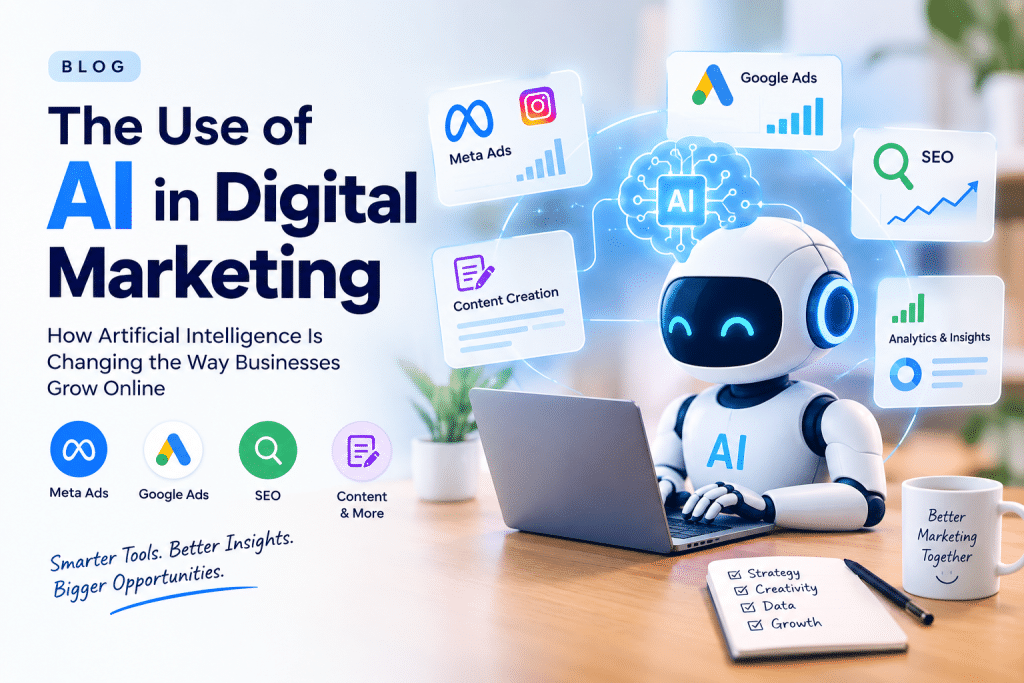
Digital marketing has become increasingly competitive. Customers interact with brands across search engines, social media, websites, email, mobile apps, and other channels.
This creates an enormous amount of customer data.
Manually analyzing all this information is difficult and time-consuming. AI helps marketers turn that data into actionable insights.
Some of the biggest reasons businesses are adopting AI include:
- Automation: Reduce repetitive marketing tasks.
- Personalization: Deliver more relevant experiences to individual customers.
- Data analysis: Identify patterns and trends quickly.
- Efficiency: Help marketing teams accomplish more in less time.
- Better targeting: Identify audiences and potential customers more effectively.
- Optimization: Continuously improve campaigns based on performance data.
- Scalability: Support marketing operations as a business grows.
However, AI shouldn’t be viewed as a replacement for marketers. The greatest value comes from combining AI’s speed and analytical capabilities with human creativity, strategy, judgment, and empathy.
What Is AI in Digital Marketing?
AI in digital marketing refers to the use of artificial intelligence technologies to analyze data, understand customer behavior, automate repetitive tasks, generate content, and make marketing decisions.
Traditional marketing often relies heavily on manual analysis and assumptions. AI, on the other hand, can process enormous amounts of data and identify patterns much faster.
For example, AI can help marketers answer questions such as:
- What type of content does my audience prefer?
- Which customers are most likely to make a purchase?
- What time should I send an email?
- Which advertising campaign is generating the best results?
- What products might a customer be interested in?
- What keywords and topics should I target?
The result is a marketing approach that can be faster, more personalized, data-driven, and scalable.
Why Is AI Becoming Important in Digital Marketing?
Digital marketing has become increasingly competitive. Customers interact with brands across search engines, social media, websites, email, mobile apps, and other channels.
This creates an enormous amount of customer data.
Manually analyzing all this information is difficult and time-consuming. AI helps marketers turn that data into actionable insights.
Some of the biggest reasons businesses are adopting AI include:
- Automation: Reduce repetitive marketing tasks.
- Personalization: Deliver more relevant experiences to individual customers.
- Data analysis: Identify patterns and trends quickly.
- Efficiency: Help marketing teams accomplish more in less time.
- Better targeting: Identify audiences and potential customers more effectively.
- Optimization: Continuously improve campaigns based on performance data.
- Scalability: Support marketing operations as a business grows.
AI in Social Media Marketing
Managing multiple social media channels can be challenging.
AI can help marketers generate content ideas, identify trends, repurpose content, analyze engagement, and assist with scheduling.
For example, a long-form blog post can be transformed into:
- LinkedIn posts
- Instagram captions
- Short-video scripts
- X posts
- Carousel ideas
- Email newsletter content
This allows marketers to get more value from a single piece of high-quality content.
AI can also help analyze which content formats and topics generate the strongest audience response.
10 Powerful Uses of AI in Digital Marketing
1. AI-Powered Content Creation
One of the most visible applications of AI is content creation.
AI tools can assist marketers in generating:
- Blog outlines
- Social media posts
- Email drafts
- Product descriptions
- Ad copy
- Video scripts
- Headlines
- Content ideas
- FAQs
This can dramatically reduce the time required to move from an idea to a first draft.
But there is an important distinction: AI-generated content isn’t automatically high-quality content.
Successful marketers use AI as a creative assistant rather than simply publishing everything it produces.
A strong workflow looks like this:
AI generates ideas → marketer adds expertise → content is fact-checked → human edits and improves → final content is published.
This approach helps maintain originality, accuracy, brand voice, and audience trust.
2. Personalized Marketing
Customers don’t want to feel like they’re receiving the same message as everyone else.
AI can analyze customer interactions, preferences, browsing behavior, purchase history, and engagement patterns to help businesses deliver more relevant experiences.
For example, an online store might recommend products based on a customer’s previous purchases.
An email campaign could show different product recommendations to different customer segments.
A streaming platform might recommend content based on viewing behavior.
This level of personalization can make marketing more relevant and potentially improve engagement and conversions
3. AI Chatbots and Conversational Marketing
AI-powered chatbots are changing the way businesses communicate with customers.
Instead of waiting for a support representative, visitors can receive immediate answers to common questions.
Chatbots can help with:
- Product questions
- Order tracking
- Appointment scheduling
- Lead qualification
- Frequently asked questions
- Basic customer support
- Product recommendations
For businesses, this can reduce response times while allowing human teams to focus on more complex customer issues.
The key is knowing when automation should hand the conversation over to a human.
AI in Email Marketing: How Artificial Intelligence Is Transforming Email Campaigns
Email marketing remains one of the most effective ways for businesses to build relationships with customers, generate leads, and drive sales. But as inboxes become increasingly crowded, sending the same email to every subscriber is no longer enough.
This is where artificial intelligence (AI) in email marketing can make a significant difference.
AI enables marketers to analyze customer behavior, personalize content, automate campaigns, predict engagement, and optimize emails based on data. Instead of relying entirely on guesswork, marketers can use AI to deliver the right message to the right person at the right time.